
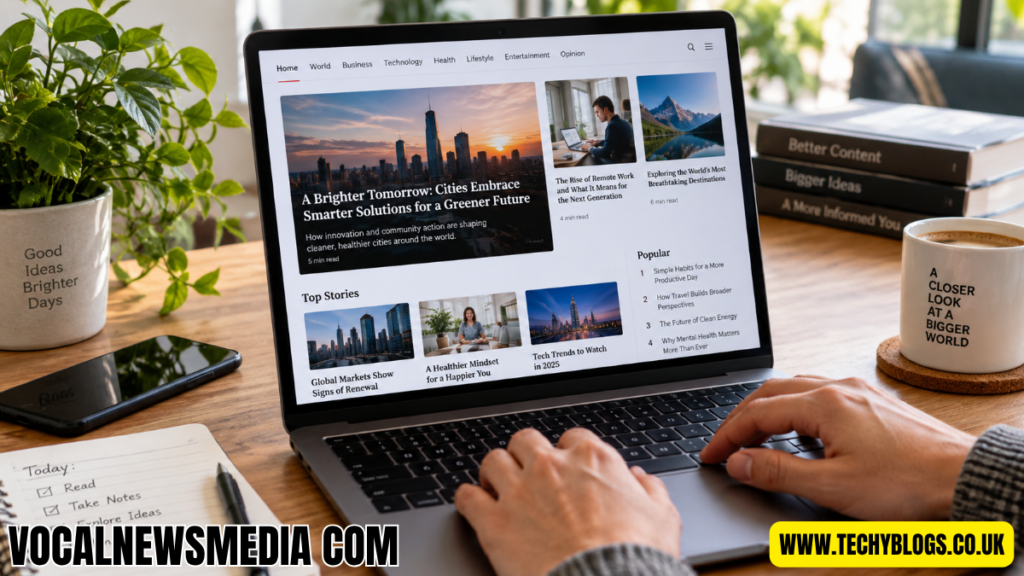

There are thousands of websites competing for attention in search results, and many of them are difficult to judge from the name alone. A site may look like a traditional news publication, a niche blog, or a general information hub, yet operate quite differently once you start exploring its articles.
That is the main reason people searching for vocalnewsmedia com tend to want more than a basic description. They want to know what kind of website it is, what subjects it covers, how useful its articles are, and how much confidence they should place in the information they find there.
A look at the current site shows a broad publishing model rather than a narrow news operation. Its homepage features articles spanning business, artificial intelligence, literature, lifestyle topics, consumer information, technology, and general-interest subjects. The category archive goes even wider, listing areas such as health, entertainment, finance, education, law, crypto, travel, real estate, automobiles, and technology.
That variety is the platform’s biggest strength, but it is also the reason readers need to understand exactly what they are using.
What is vocalnewsmedia com actually designed to do?
Vocal News Media operates primarily as a multi-topic digital publishing website. Instead of specializing in one subject—such as financial markets, sports, software, or politics—it publishes content across a large collection of categories.
The current category counts show just how broad the site has become. Its archive lists 33 entertainment posts, 32 health posts, 19 blog posts, 17 business articles, 13 technology articles, eight education posts, and seven finance articles, along with smaller collections covering AI, automobiles, crypto, fashion, law, travel, real estate, trading, and other subjects.
That tells you something important about the site before you even read an article: it is built for discovery.
A visitor might arrive looking for a business topic and later move into technology, education, entertainment, or a lifestyle article. This is different from visiting a specialist publication where nearly every page assumes a shared interest or level of expertise.
For casual readers, that flexibility can be useful. You do not need to understand the site’s entire editorial identity before finding something worth reading.
What kind of articles can you find there?
The easiest way to understand the platform is to look at actual examples instead of relying on labels such as “news website.”
Recent homepage content includes an article about SoSoActive and digital growth, a summary of Isaac Asimov’s The Fun They Had, a book review, a guide to AI skills for children, business-focused articles, and practical consumer pieces about topics such as hot water heater replacement.
Older material expands the range further. The homepage currently surfaces articles discussing cloud hosting, data-analysis tools, cybercrime attorneys, car insurance, personal injury law, online platforms, health topics, and business operations.
This is why I would not describe Vocal News Media as a conventional breaking-news destination. The word “news” appears in the branding, but the actual content mix is closer to a general digital magazine combined with an informational blog.
That distinction matters.
If you visit expecting minute-by-minute coverage of a Federal Reserve announcement, election result, hurricane warning, or stock-market event, a dedicated news organization is likely to serve you better. If you are browsing for readable explainers, introductions to unfamiliar subjects, business ideas, digital trends, or lifestyle material, the site’s broad format makes more sense.
The biggest advantage is variety
Some readers dislike broad websites because they prefer deep specialization. I think that criticism misses one of the genuine benefits of this model.
A multi-category site is useful when you are still exploring a topic.
Imagine you are researching AI because your child’s school has started introducing generative tools. You may begin with the site’s article about AI skills children should learn, then move into its broader technology section. Another visitor might arrive through a business article, discover information about customer-service knowledge management, and later browse finance content.
The homepage is structured around multiple content areas and repeated article sections rather than forcing every visitor down one narrow path. It also displays author names such as Shivi Hyde and Devin Haney on numerous posts, giving readers at least a visible byline to follow when browsing related material.
For a general-reading site, that kind of navigation works.
Where readers should be more careful
The mistake people make with websites like this is asking only, “Is it legit?”
That question is too simplistic.
A website can be real, actively maintained, and perfectly useful for discovering topics while still not being the source you should use for a high-stakes decision.
For example, suppose you read a general article about personal injury law and then need to decide whether to accept a $25,000 insurance settlement after a car accident. At that point, you should be consulting a licensed attorney in your state, not treating a general article as individualized legal advice.
The same applies to health and money.
If an article discusses muscle building, insurance, investing, medication, or a medical procedure, use it as a starting point. Then verify important claims through primary or authoritative sources. The current site includes substantial health, finance, law, and crypto categories, which makes this habit especially important.
Here is the rule I use: the greater the consequence of being wrong, the stronger the source needs to be.
How I would evaluate an article before trusting it
Most guides tell readers to “check whether the website looks professional.” That is weak advice. A polished WordPress theme can be installed in an afternoon.
Instead, inspect the individual article.
Look for four things:
- Specific evidence. Does the article link to an original study, government agency, company filing, court document, or official source when making a factual claim?
- Author accountability. Is there a named writer, and can you tell whether the person has relevant experience?
- Dates and context. A technology guide from 2021 can be badly outdated in 2026 even if it was accurate when published.
- Claims that can be independently checked. If an article says a law changed, a company released a product, or a medical study found something significant, confirm it elsewhere.
This process takes two or three minutes and is much more useful than judging an entire domain with a single “safe” or “unsafe” label.
Is the content aimed at American readers?
Not exclusively.
The site contains subjects that can appeal to US readers, particularly business, technology, finance, health, and consumer topics, but its content is clearly international. One current business article discusses indoor team-building activities in Singapore, while another covers shipping to Bulgaria.
For an American visitor, that is not necessarily a drawback. It simply means local relevance should be checked.
A legal article, for example, may not reflect the rules in California, Texas, New York, or Florida. An insurance article may discuss general principles without accounting for state-specific requirements. A consumer recommendation may also reference services or pricing that differ significantly from what someone in the United States can access.
Location matters most when regulations, prices, taxes, health systems, or available services are involved.
What makes the site different from a traditional newsroom?
Traditional newsrooms typically build their reputations around reporting infrastructure: editors, reporters, corrections policies, sourcing standards, investigative work, and clearly defined beats.
Vocal News Media’s public-facing homepage currently looks much more like a broad content publication. It organizes posts into categories and sections such as business, technology, lifestyle, entertainment, local news, world news, and other themed areas, while publishing explainers and evergreen articles alongside more topical material.
That does not make the content automatically unreliable. It simply means readers should judge it by the standards of a general information platform rather than assuming every page has gone through the same reporting process as an Associated Press or Reuters story.
Personally, I think this is the most useful way to approach the site. Use it to learn what a topic is about, discover questions you did not know to ask, and find subjects worth investigating further. Do not outsource your entire fact-checking process to any single general-interest website.
Who will probably get the most value from it?
The site makes the most sense for curious readers who like browsing rather than following one narrow beat.
A small-business owner might find an article about customer-service knowledge management. A parent could discover a piece about AI education. Someone researching technology might explore cloud-hosting or data-analysis topics. Another reader might simply want entertainment or lifestyle content during a lunch break.
That is a different use case from academic research or professional due diligence.
If I were preparing a university paper, buying $10,000 worth of stock, choosing medical treatment, or filing a lawsuit, I would move from a general article to primary sources very quickly.
For ordinary exploration, the threshold is lower.
FAQs
Is Vocal News Media a real website?
Yes. It is an active publishing website with a current homepage, multiple content categories, named article bylines, archives, and posts dating across several years. Its homepage and category listings were accessible when checked in September 2026.
What does Vocal News Media publish?
It publishes general-interest articles across business, technology, health, entertainment, education, finance, AI, law, lifestyle, travel, crypto, and several other categories. Entertainment and health are currently among its largest visible categories.
Can I use its articles for research?
Yes for initial research, but important claims should be verified through stronger primary sources. For academic work, cite the original study, government publication, official company document, or other source behind the claim whenever possible.
Is everything on the site US-focused?
No. The publication covers internationally relevant subjects as well as topics useful to American readers. Current examples include content related to Singapore workplaces and shipping to Bulgaria, so readers should check whether advice applies to their own state or country.
Should I trust health, finance, or legal articles there?
Treat them as general information rather than personalized professional advice. Before making a medical, financial, or legal decision, verify the important details with authoritative sources and an appropriately qualified professional when the stakes justify it.
The best way to use vocalnewsmedia com is as a broad discovery platform rather than a substitute for every specialized source on the internet. Its range is genuinely useful: you can move from technology to business, education, health, entertainment, and lifestyle content without leaving the site. The trade-off is that readers need to apply their own source-checking habits, especially when an article deals with money, law, health, or other decisions where accuracy has real consequences.